
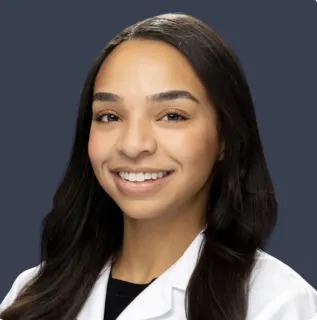
- Title/Role: Resident, Dept. of Otolaryngology - Head and Neck Surgery
- PGY: 3
- Program/Location: MedStar Georgetown University Hospital, Washington, D.C.
What inspired you to pursue a career in healthcare?
Growing up in Cleveland, I saw firsthand how a difference of just a few miles could dramatically affect access to education, healthcare, nutritious food, and safe environments. Witnessing those disparities sparked my interest in addressing the social determinants of health. I initially pursued that goal as a teacher in an underserved school, but I eventually realized I wanted to make a more direct impact on patients’ health and wellbeing. That path led me to medicine and, after I discovered my love for surgery and head and neck anatomy, ultimately to otolaryngology.
Describe what your daily life is like as a resident (or send us a reel!).
A typical day usually starts around 6 a.m. with prerounding on our inpatients and consults, followed by running the list with the team, updating attendings, and managing notes, orders, and consults. After that, we head to the OR, where cases can range from a 15-minute ear tube set to a 12-hour cancer ablation with free flap reconstruction.
Every day, there is a strong sense of teamwork among my co-residents. If there’s any downtime, we always jump in to help whoever is carrying the pager or seeing consults. On a good day, I finish in time to go straight to the gym or a workout class before heading home to eat, review the next day’s cases, and get some rest.
What do you enjoy most about your specialty?
I love the variety that comes with otolaryngology. We focus on a single anatomical region, yet within that scope we treat an incredible range of patients and diseases. On any given day, I might care for a child with recurrent ear infections, a healthy adult seeking a quality-of-life procedure such as a septoplasty, a patient undergoing treatment for head and neck cancer, or someone with an emergent, difficult airway. That breadth allows you to become a true expert in the head and neck without ever feeling limited or repetitive.
What has helped you succeed at MedStar Health?
I think the biggest factor has been my co-residents. Surgical training is demanding, and having a group that genuinely supports one another makes a huge difference. I’ve also appreciated how accessible our attendings are. On the institutional side, GME has been very supportive, providing meal access during long shifts and funding for educational resources and equipment, such as my surgical loupes.
What's something that most people may not understand about medical training?
Many people may not realize how much responsibility residents have in patient care. We are often the physicians who spend the most time with patients, coordinating care and ensuring things move forward. While every decision is made under direct attending oversight, residents take great pride in that responsibility and are deeply invested in achieving the best possible outcomes for our patients.
What ways do you prioritize your wellbeing and/or help your colleagues do the same?
I prioritize my wellbeing by exercising several times a week. I enjoy strength training, cycling, and Pilates. I especially appreciate it during weeks with long surgical cases, when I may spend most of the day standing in one place.
As a residency program, we also make a conscious effort to support one another. We celebrate birthdays, organize dinners and happy hours, and make a point to spend time together outside the hospital. More importantly, we help each other with day-to-day work. No task is too small for anyone, regardless of training level, and everyone pitches in to make sure the work gets done so no one person is left staying late alone.
What would be your top piece of advice for other residents and fellows?
My biggest piece of advice is to be honest, helpful, and reliable with your co-residents. A program’s culture is built by the people in it, and when everyone is willing to support one another, that energy amplifies. I also try to remember every day that caring for patients is both a privilege and a responsibility. Finally, take care of yourself. Residency is demanding, and you cannot consistently care for others if you are not taking care of yourself first.
What do you envision for the future of medicine? How do you see yourself in that future?
I think the future of medicine will require all of us to take a more active role in addressing health disparities. That responsibility does not fall solely to primary care physicians. Specialists also play an important role in improving access to care and advocating for patients. This is especially important in head and neck cancer, where Black patients continue to experience disproportionately worse outcomes. As an otolaryngologist, I hope to contribute through patient care, research, and community outreach, working to make specialty care more equitable and accessible.